You have no items in your shopping cart.

Filter by attributes
- Audience
Oxford University Press

Why Deregulate Labour Markets?
Europe's mass unemployment and the call for extensive labour market de-regulation have, perhaps more than any other contemporary issue, impassioned political debate and academic research. With contributions from economists, political scientists and sociologists, Why Deregulate Labour Markets? takes a hard look at the empirical connections between unemployment and regulation in Europe today, utilizing both in-depth nation analyses and broader-based international comparisons.
$175.95

Why Deregulate Labour Markets?
Europe's mass unemployment and the call for extensive labour market de-regulation have, perhaps more than any other contemporary issue, impassioned political debate and academic research. With contributions from economists, political scientists and sociologists, Why Deregulate Labour Markets? takes a hard look at the empirical connections between unemployment and regulation in Europe today, utilizing both in-depth nation analyses and broader-based international comparisons.
$371.00

Why Do You Ask?
This collected volume, featuring an international roster of well-known scholars, is the first to focus solely on the question/answer process, drawing on a range of methodological approaches like Conversational Analysis, Discourse Analysis, Discursive Psychology, and Sociolinguistics-and using as data not just medical, legal, and educational environments, but also less-studied institutions like telephone call centers, broadcast journalism (i.e. talk show interviews), academia, and telemarketing.
$96.95

Why Does Inequality Matter?
Inequality is widely regarded as morally objectionable; T. M. Scanlon investigates why it matters to us. He considers the nature and importance of equality of opportunity, whether the pursuit of greater equality involves objectionable interference with individual liberty, and whether the rich can be said to deserve their greater rewards.
$60.95

Why Does Inequality Matter?
Inequality is widely regarded as morally objectionable: T. M. Scanlon investigates why it matters to us. He considers the nature and importance of equality of opportunity, whether the pursuit of greater equality involves objectionable interference with individual liberty, and whether the rich can be said to deserve their greater rewards.
$40.95

Why Does Tragedy Give Pleasure?
Why does tragedy give pleasure? Why do people who are neither wicked nor depraved enjoy watching plays about suffering and death? Is it because we see horrific matter controlled by majestic art? Or because tragedy actually reaches out to the dark side of human nature? A. D. Nuttall's wide-ranging, lively, and engaging book offers a new answer to this perennial question. Writers discussed include Aristotle, Shakespeare, Nietzsche, and Freud.
$137.95

Why Ecosystems Matter Preserving the Key to Our Survival
Darwin gained a profound insight into how complex ecosystems evolve through the interactions of their species. Here, visiting some remarkable ecosystems, Christopher Wills explains the recent scientific advances that allow us to measure the evolutionary drivers powering their diversity and resilience, and can enable us to protect and restore them.
$74.95
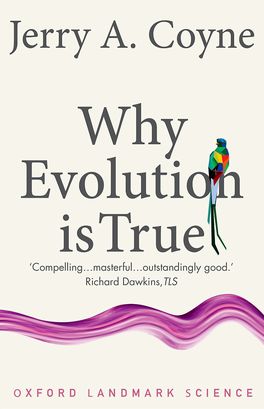
Why Evolution is True
Why Evolution is True focuses on the hard evidence that proves evolution by natural selection to be a fact. Weaving together and explaining the latest discoveries and ideas from many disparate areas of modern science, this succinct and important book will leave no one with an open mind in any doubt about the truth - and the beauty - of evolution.
$25.95

Why History?
What is the point of history? Why has the study of the past been so important for so long? Why History? A History contemplates two and a half thousand years of historianship to establish how very different historians have conceived their activities, and to show the purposes that their work has served.
$100.95